
True 4K Ultra-HD IPTV Streaming in Canada
Understand the technical reality of 4K IPTV: native 3840x2160 resolution, modern HEVC & AV1 video compression, 60 FPS sports feeds, and how to verify real Ultra-HD streaming without marketing gimmicks.
Real Customer Reviews & WhatsApp Confirmations
No fabricated claims or stock testimonials. Real, unedited WhatsApp screenshots from active subscribers across Montreal, Quebec, Toronto, and Vancouver.
Client Canada 173
Montreal & Quebec City, QC
"Very good it works well I'll take 1 year subs"
Canadian Firestick User
Toronto, ON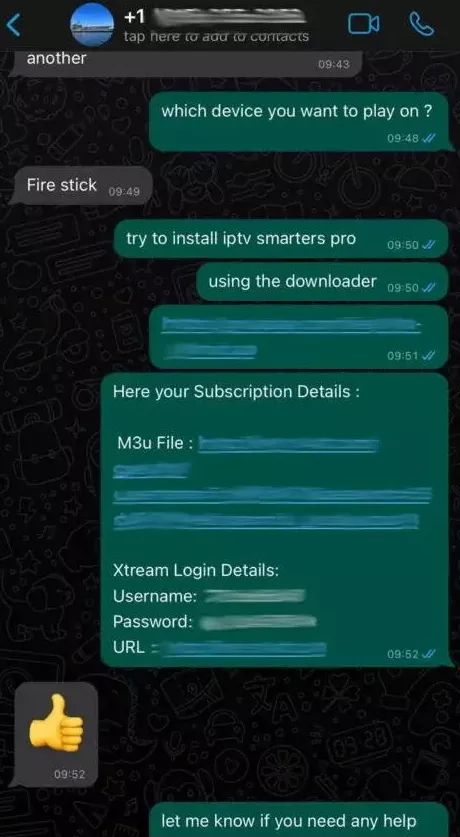
"Here your Subscription Details... Fire stick setup with IPTV Smarters Pro 👍"
Subscriber from British Columbia
Vancouver, BC
"Working great buddy I will get more for sure. Thanks man have a great weekend!"
Canada Client 114
Gatineau & Ottawa Region
"Payment confirmed, done! I continue to use this link? Fast and simple renewal."
Client Région de Laval
Laval, QC
"I paid for a year subscription... start from today, Enjoy! Ok logging in now"
Abonné John - Western Canada
Calgary & Edmonton, AB
"M3u & Xtream Login delivered... OK got it thanks for your help!"
Client Canada 173
Montreal & Quebec City, QC"Very good it works well I'll take 1 year subs"
Canadian Firestick User
Toronto, ON"Here your Subscription Details... Fire stick setup with IPTV Smarters Pro 👍"
Subscriber from British Columbia
Vancouver, BC"Working great buddy I will get more for sure. Thanks man have a great weekend!"
Canada Client 114
Gatineau & Ottawa Region"Payment confirmed, done! I continue to use this link? Fast and simple renewal."
Client Région de Laval
Laval, QC"I paid for a year subscription... start from today, Enjoy! Ok logging in now"
Abonné John - Western Canada
Calgary & Edmonton, AB"M3u & Xtream Login delivered... OK got it thanks for your help!"
What Is True 4K IPTV? Separating Fact from Marketing Claims
Understanding 3840x2160 pixel density, encoding bitrates, and native broadcast sources
Ultra High Definition (UHD), commonly referred to as 4K, delivers a resolution of 3840 by 2160 pixels—precisely four times the pixel count of standard Full HD (1920x1080). This dramatic leap in pixel density provides razor-sharp clarity, discernible jersey numbers from wide stadium angles, and photorealistic detail on modern large screens measuring 55 inches and above.
However, the term "4K" is frequently misused in the IPTV industry. Many discount providers take standard 720p or 1080p feeds and run them through hardware upscalers, re-encoding them at low bitrates while slapping a "4K" label on the channel name. This artificial processing does not add true detail; instead, it frequently introduces compression artifacts and frame drops.
At IPTV Canada 4K, we maintain strict technical honesty: native 4K streams are sourced from genuine 4K UHD production trucks and broadcast feeds (such as select NHL marquee games, major international tournaments, and premium documentary programming). For standard events broadcast in 1080p, we deliver uncompressed high-bitrate 1080p60 feeds rather than misleading upscales.
Video Compression Standards: HEVC / H.265 vs. AVC / H.264
How advanced codecs achieve superior visual fidelity without choking your home network
Transmitting raw, uncompressed 4K video requires over 12 Gigabits per second—far beyond the capacity of residential consumer broadband. To make 4K streaming feasible over Canadian residential internet connections, streams must be encoded using High Efficiency Video Coding (HEVC / H.265) or the newer open-source AV1 codec.
HEVC is approximately 50% more efficient than older H.264 compression. It allows our servers to stream pristine 4K video at bitrates between 25 and 35 Mbps. However, HEVC playback requires hardware decoding support on your streaming device. Fortunately, virtually all modern streaming devices produced after 2019 (such as the Amazon Fire TV Stick 4K Max, Apple TV 4K, and Google Chromecast with Google TV) feature dedicated HEVC silicon decoders.
| Resolution Standard | Pixels Per Frame | Aspect Ratio | Typical Bitrate | Primary Codec |
|---|---|---|---|---|
| Standard Definition (SD) | 720 x 480 | 16:9 / 4:3 | 2.5 - 4.0 Mbps | MPEG-2 / H.264 |
| High Definition (HD) | 1280 x 720 | 16:9 | 5.0 - 8.0 Mbps | H.264 (AVC) |
| Full High Definition (FHD) | 1920 x 1080 | 16:9 | 12.0 - 16.0 Mbps | H.264 / H.265 (60 FPS) |
| Ultra High Definition (4K UHD) | 3840 x 2160 | 16:9 | 25.0 - 35.0 Mbps | H.265 (HEVC) / AV1 |
Internet Speed & Home Network Requirements for 4K
Ensuring your home network can handle sustained 35 Mbps throughput without drops
To stream 4K Ultra-HD without buffering, your internet connection must provide a continuous, stable download speed of at least 25 Mbps dedicated exclusively to the video stream. If other members of your household are simultaneously downloading game updates, participating in Zoom video conferences, or streaming video on other screens, a base residential internet plan of 75 to 100 Mbps or higher is strongly recommended.
Furthermore, continuous streaming requires low packet loss and stable jitter. We strongly advise connecting your 4K streaming box or Smart TV via a physical Cat 6 Ethernet cable whenever possible. If Wi-Fi is required, ensure your device is connected to the 5 GHz or 6 GHz (Wi-Fi 6/6E) band rather than the overcrowded 2.4 GHz spectrum.
To display 4K at 60 FPS with HDR10 or Dolby Vision, ensure your streaming device is connected to your television using an HDMI 2.0 or HDMI 2.1 certified High-Speed cable. Older HDMI 1.4 cables are limited to 4K at 30 FPS, causing choppy sports playback.
Clear Answers for Canadian Viewers
Authentic, fact-checked answers addressing setup, ISP compatibility, and channel access.
Related Canadian Streaming Guides
Canadian Internet Speed Calculator & Guide
Test your connection and calculate bandwidth requirements across Canadian ISPs.
Buffer Troubleshooting Guide
Discover practical solutions to eliminate stuttering and stream drops.
Compatible 4K Streaming Devices
Compare Firestick 4K Max, Apple TV 4K, and Android TV hardware.