📋 Table of Contents
- What Determines Whether IPTV Is Legal in Canada?
- Legal IPTV vs. Illegal IPTV — The Key Differences
- The Canadian Copyright Act and IPTV
- CRTC Regulation of IPTV in Canada
- Canadian Court Cases Involving IPTV
- Fully Legal IPTV — Bell Fibe, TELUS Optik, and ISP Services
- Third-Party IPTV Services in Canada — The Legal Reality
- What Are the Real Risks of Using Unlicensed IPTV in Canada?
- How to Identify a Legal IPTV Service in Canada
- Does Using a VPN Make IPTV Legal in Canada?
- Does IPTV Legality Vary by Province in Canada?
- How Canada Compares to Other Countries on IPTV Law
- Frequently Asked Questions
- Conclusion — How to Watch IPTV Legally in Canada
What Determines Whether IPTV Is Legal in Canada?
The question "is IPTV illegal in Canada?" is asked by millions of Canadians every year, and the confusion is understandable. IPTV — Internet Protocol Television — is simply a delivery technology. It is as neutral as a television set, a Wi-Fi router, or an internet browser. The technology itself has no inherent legal status; it is a method, not a product.
What the law cares about is not the delivery mechanism — the "IP" part — but whether the content being delivered was obtained and redistributed with the permission of the copyright holders. This is the core of Canadian copyright law as it applies to IPTV, and it is the only factor that determines whether any given IPTV usage is legal or illegal.
To make this absolutely clear: Bell Fibe TV uses IPTV technology. So does TELUS Optik TV, one of Canada's largest television services. Both are completely legal, CRTC-regulated, and used by millions of Canadians. The fact that they use IPTV to deliver content does not raise any legal concern whatsoever — because they hold proper licences for every channel and piece of content they broadcast.
The legal question only becomes meaningful when you introduce IPTV services that do not hold content licences — services that copy and rebroadcast channels and movies without authorization from the rights holders. This is where Canadian copyright law comes into play.
The Three Factors That Determine IPTV Legality
Content Licensing
Does the IPTV provider hold valid broadcast licences and content agreements for every channel and piece of content it streams? This is the primary legal test under the Copyright Act.
CRTC Compliance
Is the service operating in compliance with CRTC broadcasting regulations? Licensed Canadian broadcasters must meet CRTC requirements for Canadian content and distribution.
User Intent & Knowledge
Is the user knowingly accessing content through a service they know to be unlicensed? Canadian courts consider whether infringement was intentional or commercial in nature when assessing liability.
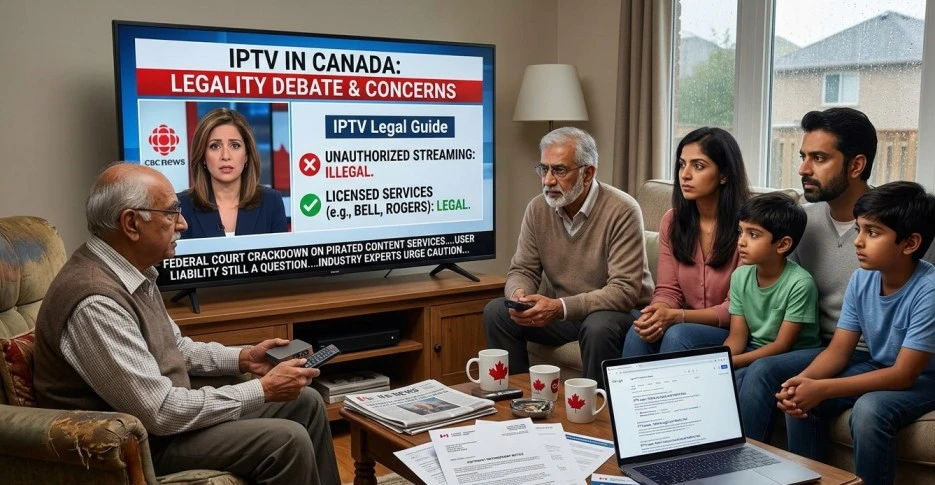
Legal IPTV vs. Illegal IPTV — The Key Differences
To practically answer "is IPTV legal in Canada?", you need to understand the fundamental difference between a legal IPTV service and an illegal one. The table below summarizes the key distinguishing factors.
| Factor | Legal IPTV Service | Illegal / Piracy IPTV Service |
|---|---|---|
| Content Licensing | ✓ Licensed — Rights held for all content | ✗ Unlicensed — No content rights held |
| Business Transparency | Registered company, identifiable ownership | Anonymous, no verifiable company details |
| CRTC Status | Compliant / licensed where required | Not registered, no CRTC licence |
| Price Range | Reflects content licensing costs | Often suspiciously low ($5–$15 for "everything") |
| Customer Support | Formal support infrastructure, tickets, phone | Minimal / disappears after payment |
| Terms of Service | Clear, comprehensive ToS and privacy policy | Non-existent or generic placeholder |
| Copyright Holder Relations | Content delivered with rights holder permission | Content taken without permission |
| Legal Risk (User) | None | Low–Medium (Canada) |
| Legal Risk (Operator) | None | Very High |
✅ Clearly Legal IPTV in Canada
- Bell Fibe TV (Bell Canada)
- TELUS Optik TV
- Videotron Helix TV
- Rogers Ignite TV
- Shaw BlueCurve TV
- Properly licensed third-party IPTV providers
- Netflix, Crave, Disney+ (OTT streaming — a form of IPTV technology)
- CBC Gem, CTV app, Global TV app
✗ Legally Questionable / Illegal IPTV
- Anonymous services with no company details
- Services claiming "50,000 channels" for $5/month
- Services that restream copyrighted channels without licences
- Piracy IPTV boxes pre-loaded with unlicensed streams
- Kodi builds with unlicensed stream add-ons
- Services blocked by CRTC website-blocking orders
- IPTV resellers of clearly piracy-based services
The Canadian Copyright Act and IPTV — What the Law Actually Says
The primary Canadian legislation governing IPTV legality is the Copyright Act (R.S.C., 1985, c. C-42), as amended most recently by the Copyright Modernization Act (2012). Understanding the key provisions that apply to IPTV gives you a solid foundation for understanding the legal landscape.
Copyright and Broadcasting in Canada
Under the Copyright Act, content creators and broadcasters hold copyright in their works — television programs, films, sports broadcasts, news programming, and so on. Holding copyright means that only the rights holder (or those they have licensed) can legally reproduce, communicate, or make available that content to the public.
When an IPTV service rebroadcasts a TV channel — say, a live sports event on TSN — without a licence from TSN and the underlying rights holders (leagues, teams, producers), it is making an unauthorized "communication to the public by telecommunication" — a right that is exclusively reserved for the copyright holders under Section 3(1)(f) of the Copyright Act.
This is the legal mechanism that makes the operation of unlicensed IPTV services illegal in Canada. The service is communicating copyrighted content to the public without authorization.
What About the User Who Watches Unlicensed IPTV?
This is a crucial distinction that many Canadians are unclear on. The Copyright Act creates a meaningful legal difference between:
- The operator of an unlicensed IPTV service (clearly infringing — they are communicating copyrighted works to the public without a licence)
- The end-user who receives and watches those streams (a more legally nuanced question)
Under Canadian copyright law, simply receiving an infringing broadcast does not automatically make you liable in the same way as the operator. The 2012 Copyright Modernization Act introduced a "making available" right targeted at those who make content available for download or streaming — which primarily targets the distributor, not the individual viewer.
However, if you knowingly subscribe to and pay for a service that you know is infringing copyright, you are likely participating in infringement as a consumer. Canadian courts would consider factors like whether you knew the service lacked proper licences and whether your support was commercial in nature (i.e., you paid for it).
In practice, the Canadian music and television industries, alongside CRTC enforcement, have focused their legal actions almost entirely on operators and distributors of piracy IPTV services — not on individual end-users watching content.
The 2012 Copyright Modernization Act — Key Updates
The Copyright Modernization Act (Bill C-11), which came into force in 2012, significantly updated Canadian copyright law for the digital age. Several of its provisions are directly relevant to IPTV:
- Making Available Right (Section 2.4(1.1)): Makes it clear that putting content online where users can access it constitutes "communication to the public by telecommunication" — this solidifies the illegality of running unlicensed IPTV services.
- Expanded ISP Safe Harbours: Internet Service Providers are generally not liable for the infringing content that passes through their networks, provided they are passive conduits and comply with notice-and-notice obligations.
- Notice and Notice Regime (Sections 41.25–41.27): Requires ISPs to forward copyright infringement notices from rights holders to their customers who are suspected of infringement. This is Canada's alternative to the stricter "notice and takedown" system used in the US.
- Time Shifting and Personal Use Exceptions: Allows individuals to record broadcast content for their personal use (time-shifting) — relevant to catch-up TV features in legal IPTV services.
The Notice and Notice Regime
Canada's notice-and-notice system is worth understanding if you're concerned about using IPTV. Under this system, if a copyright holder identifies an IP address that they believe is infringing their copyright (e.g., by using an unlicensed IPTV service), they can send a notice to the subscriber's ISP. The ISP is legally required to forward that notice to the subscriber — but importantly, it is not required to disclose the subscriber's identity to the copyright holder or to take down the service.
Receiving such a notice is a warning — it does not mean you have been found liable or fined. However, repeated notices or continued infringement after receiving one could be taken into account if legal proceedings were ever pursued against an individual.
Legal Disclaimer: This article is for general informational purposes only and does not constitute legal advice. IPTV law in Canada is complex and evolving. If you have specific legal concerns about your IPTV usage or are operating an IPTV service, you should consult a qualified Canadian copyright lawyer.
CRTC Regulation of IPTV in Canada
The Canadian Radio-television and Telecommunications Commission (CRTC) is the federal regulatory body that oversees broadcasting and telecommunications in Canada. Its mandate under the Broadcasting Act (S.C. 1991, c. 11, recently updated by Bill C-11, the Online Streaming Act of 2023) has significant implications for IPTV services operating in or targeting Canadian audiences.
The CRTC's Role in IPTV Oversight
The CRTC regulates broadcasting in the public interest, with particular attention to:
- Ensuring Canadian broadcasting reflects Canadian culture and values
- Mandating Canadian Content (CanCon) requirements for licensed broadcasters
- Licensing Canadian broadcasting services, including IPTV providers
- Protecting consumers from unauthorized or piracy broadcasting services
ISP-managed IPTV services like Bell Fibe TV and TELUS Optik TV operate under CRTC broadcasting licences and comply with Canadian content regulations. Third-party IPTV services, particularly those based outside Canada, typically operate outside the CRTC's licensing framework — which is one reason their regulatory status is murky.
The CRTC Website Blocking Initiative (FairPlay Canada)
In 2018, a coalition of Canadian media companies under the banner FairPlay Canada — including Bell Media, Corus, Quebecor, and Rogers — filed an application with the CRTC requesting the creation of a piracy website-blocking system. The proposal asked the CRTC to order all Canadian ISPs to block access to websites and IPTV services that distribute pirated content.
The CRTC ultimately determined in 2018 that it did not have jurisdiction to implement such a blocking system under the existing Broadcasting Act. However, the issue was not laid to rest — rights holders pursued blocking orders through the Federal Court instead.
Federal Court Website Blocking Orders
Canadian courts have shown willingness to grant website-blocking orders targeting piracy IPTV services. In a series of precedent-setting Federal Court decisions, Canadian broadcasters and sports leagues have obtained orders requiring major Canadian ISPs to block access to specified piracy IPTV services and their associated domains and IP addresses.
These blocking orders represent a growing legal mechanism for combatting IPTV piracy in Canada, even in the absence of a CRTC-administered system. The practical effect for consumers is that some piracy IPTV services become inaccessible on major Canadian ISPs like Bell, Rogers, Telus, and Shaw.
Bill C-11 — The Online Streaming Act (2023)
The federal government passed Bill C-11 (the Online Streaming Act) in 2023, significantly updating the Broadcasting Act for the first time in over 30 years. Key implications for IPTV include:
- Online streaming services (including large IPTV platforms) serving Canadian audiences may be required to register with the CRTC and contribute to Canadian content funds.
- The updated Act broadens the CRTC's jurisdiction over online broadcasting, potentially bringing more IPTV services under regulatory oversight.
- Foreign IPTV services with significant Canadian audiences could face obligations to fund Canadian content production.
The CRTC is still developing the specific regulatory framework under Bill C-11, and its full implications for third-party IPTV services remain to be seen as of 2026.
Canadian Court Cases Involving IPTV Piracy
Canadian courts have heard a growing number of cases involving unlicensed IPTV services. These cases establish the legal precedents that define what is and isn't permitted in Canada's IPTV landscape.
Bell v. Goldtv (2019) — A Landmark Piracy Blocking Case
In 2019, Bell Canada and its broadcasting affiliates obtained a landmark Federal Court order requiring major Canadian ISPs — including Rogers, Telus, Videotron, and others — to block access to the GoldTV piracy IPTV service. This was one of the first cases in Canada where courts ordered ISPs to block a piracy service at the network level.
The GoldTV case established that Federal Court injunctions could be used to require ISPs to implement dynamic blocking of piracy IPTV services — meaning that as the piracy service migrated to new domains or IP addresses, the blocking orders could be updated to follow them. This "dynamic blocking" mechanism made the orders far more effective than simple static domain blocks.
Sports Organizations and Live Piracy Blocking
Canadian professional sports organizations — including the NHL, NBA, and major sports broadcasters like TSN and Sportsnet — have also pursued court-ordered blocking of live sports piracy streams in Canada. Courts have granted orders specifically targeting the illegal live streaming of NHL and NBA games, recognizing the particular harm of real-time sports piracy to broadcasting rights holders.
IPTV Box Sellers Charged Under the Copyright Act
Several Canadian individuals and businesses selling pre-configured IPTV boxes (hardware pre-loaded with software pointing to unlicensed IPTV streams) have faced civil and criminal proceedings under the Copyright Act. In these cases, courts have found that selling a device specifically designed and marketed to facilitate access to unlicensed content constitutes contributory copyright infringement.
This is particularly relevant if you are considering purchasing a "fully loaded" IPTV box marketed with phrases like "watch everything for free" or "all channels included" — such boxes are typically configured to access piracy IPTV services, and the sale of these devices has been targeted by Canadian enforcement.

Fully Legal IPTV in Canada — Bell Fibe, TELUS Optik, and ISP Services
Canada's major telecommunications companies operate their own fully licensed, CRTC-regulated IPTV services. These services are the most straightforward answer to "what is legal IPTV in Canada?" — they operate within the full framework of Canadian broadcast regulation and hold all required content licences.
Bell Fibe TV
Bell Canada's Fibe TV is an IPTV service delivered over Bell's fiber and copper internet network to subscribers in Ontario, Québec, and Atlantic Canada. It delivers live TV channels, on-demand content, and a cloud-PVR service via IP to a set-top box or the Fibe TV app on compatible devices. Fibe TV is fully licensed and regulated by the CRTC, and holds content rights for every channel it broadcasts.
TELUS Optik TV
TELUS Optik TV is TELUS's IPTV service, available to TELUS internet subscribers in British Columbia and Alberta. Like Fibe TV, Optik TV delivers channels and on-demand content over the internet to a set-top box or the Optik TV app. It is a CRTC-licensed, fully legal IPTV service with all content rights secured.
Rogers Ignite TV
Rogers Communications operates Ignite TV in Ontario, New Brunswick, and Newfoundland. While technically a hybrid IP/cable service, it uses IP delivery for its advanced features and is a fully licensed, legal broadcasting service.
Videotron Helix TV
Videotron's Helix TV, available in Québec, is a fully IP-delivered television service (IPTV) bundled with Videotron's fiber internet service. Helix TV is CRTC-licensed and completely legal.
These ISP-operated IPTV services are not just legal — they are held up by the CRTC as the model for how IPTV should operate in the Canadian broadcasting ecosystem. Their existence definitively proves that IPTV is a legal and mainstream technology in Canada.
Third-Party IPTV Services in Canada — The Legal Reality
The legal landscape gets more complex when we move beyond ISP-managed IPTV services to the broader market of third-party IPTV subscription providers. These are the services Canadians typically mean when they ask "is IPTV legal in Canada?" — independent providers offering large channel packages (often thousands of channels) via M3U playlists or Xtream Codes, accessible through apps like IPTV Smarters Pro.
The Legal Spectrum of Third-Party IPTV
Not all third-party IPTV services are the same. They exist on a legal spectrum:
| Type | Description | Legal Status |
|---|---|---|
| Licensed Reseller / Authorized Aggregator | Provider with legitimate content licensing agreements, operating transparently | Legal |
| Grey Area Services | Providers operating in jurisdictions with different copyright regimes, unclear licensing | Unclear / Debated |
| Clearly Unlicensed Piracy Services | Services restreaming copyrighted content without any licences, anonymous operators | Illegal (Copyright Infringement) |
The "Grey Area" Debate
Much of the public debate around IPTV legality in Canada centres on the so-called "grey area" — IPTV services that are not clearly licensed by Canadian standards but may operate legally under the laws of their country of incorporation. This argument is frequently made by advocates of less expensive third-party IPTV services.
The Canadian legal position is relatively clear, however: under the Copyright Act, the act of receiving and communicating copyrighted content to Canadian audiences requires authorization from the Canadian copyright holders, regardless of where the IPTV service is technically based. A server in a foreign country does not insulate a service from Canadian copyright law if it is actively soliciting and serving Canadian customers.
This is consistent with how courts in similar common law countries — the UK, Australia, and the US — have handled cross-border IPTV piracy cases.
The Responsibility of the IPTV Subscriber
As a subscriber to a third-party IPTV service, your level of legal exposure in Canada is influenced by several factors:
- Your knowledge of the service's licensing status: Were you aware the service lacked proper licences?
- Commercial vs. personal use: Are you using the service for personal viewing or are you redistributing access?
- Whether you received a notice: Have you received a notice-and-notice copyright infringement warning from your ISP?
- Scale of usage: Individual personal viewing vs. operating a commercial establishment showing unlicensed IPTV in public
The risk for individual consumers watching unlicensed IPTV privately at home is historically very low in Canada. Canadian copyright enforcement has not focused on individual subscribers. However, operating a business — such as a bar, restaurant, or hotel — that publicly screens content from an unlicensed IPTV service is a significantly higher-risk activity, as commercial copyright infringement carries more severe penalties and has been actively targeted by rights holders.
What Are the Real Risks of Using Unlicensed IPTV in Canada?
Let's address this directly and honestly, because it's what most Canadians actually want to know: what practically happens if you use an unlicensed IPTV service in Canada?
For Individual End-Users (Private Home Viewing)
The realistic risk for an individual Canadian subscriber watching unlicensed IPTV at home is currently low. Here is why:
- Canadian copyright enforcement has historically focused on the supply side (operators, distributors, sellers) rather than individual consumers.
- The notice-and-notice regime means that the worst most individual subscribers typically experience is a forwarded warning notice from their ISP — there is no automatic fine or legal action attached to receiving such a notice.
- Civil copyright litigation against individual users in Canada is extremely rare and expensive to pursue. Rights holders have generally found it more cost-effective to target service operators.
- There is no equivalent in Canada to the US-style RIAA mass-lawsuit campaigns that targeted individual downloaders in the 2000s.
Important Caveat: "Low risk" is not "no risk." The law is clear that using unlicensed IPTV to access copyrighted content is infringement. The enforcement landscape can also change. As streaming piracy becomes economically more significant for rights holders, enforcement attention could increase. This guide reflects the current (2026) enforcement reality, not a permanent prediction.
For Business Owners and Commercial Use
The risk profile changes significantly if you are using unlicensed IPTV in a commercial context. Rights holders — particularly sports leagues (NHL, NBA, NFL), broadcasters (TSN, Sportsnet, Bell Media), and film studios — actively monitor for commercial establishments showing their content through unlicensed IPTV services.
Canadian bars, restaurants, sports bars, hotels, and other public venues that screen live sports or movies using unlicensed IPTV subscriptions have been targeted with:
- Cease-and-desist letters demanding they obtain proper commercial licensing
- Civil lawsuits for copyright infringement, with potential damages awards
- Compliance inspections from organizations monitoring unauthorized commercial use
Commercial copyright infringement carries substantially higher statutory damages under the Copyright Act than personal infringement. A business showing unlicensed NHL games to paying customers faces a very different legal risk from a household with an unlicensed IPTV subscription.
For IPTV Service Operators and Resellers
Operators of unlicensed IPTV services and those who sell or distribute access to such services face the highest legal risk. Canadian courts have granted injunctions, required ISP blocking, and awarded damages against IPTV piracy operators. Criminal charges under the Copyright Act are also possible for large-scale commercial copyright infringement. Anyone operating, hosting, or reselling an unlicensed IPTV service in Canada should be aware of serious legal exposure.
How to Identify a Legal IPTV Service in Canada
One of the most practical concerns for Canadian IPTV users is how to evaluate whether a service is operating legally. Here is a comprehensive checklist you can use when assessing any IPTV service.
Signs of a Legitimate, Legal IPTV Service
- Clear company name, registered business address, and identifiable ownership — the service has a real business identity
- Transparent pricing that reflects the actual cost of content licensing — not suspiciously cheap "all channels in the world for $8/month"
- Published Terms of Service and Privacy Policy that meet standard consumer protection requirements
- Professional website with contact information, customer support channels, and billing transparency
- Content offered through recognizable, licensed sources — channels are obtained legitimately
- Refund policy or trial period offered through a proper billing system
- Does not advertise itself as "no contract, anonymous, untraceable" or make appeals to secrecy
- Responsive, professional customer support that stands behind their service
- Not listed in court-ordered blocking databases or identified in known piracy enforcement actions
- For IPTV services from Canada specifically: Canadian business registration is verifiable
Red Flags That Suggest an Unlicensed IPTV Service
- Anonymous service with no identifiable owner, company name, or registered address
- Price is extremely low compared to licensed services (e.g., $5–$12 for thousands of channels)
- Marketing focuses on "bypassing geo-blocks," "watching without being traced," or "no logs"
- Service is advertised primarily through social media without a proper website or support infrastructure
- No Terms of Service, Privacy Policy, or refund mechanism
- Payment via only cryptocurrency or untraceable methods with no formal receipts
- Claims to offer channels from every country with no geographic or licensing restrictions
- Your ISP has sent you a copyright notice relating to the service
- The service has changed its name or domain multiple times or suddenly disappeared
Does Using a VPN Make IPTV Legal in Canada?
A common misconception is that using a VPN (Virtual Private Network) while watching IPTV changes the legal status of the underlying service. This is incorrect. A VPN does not affect the legality of the IPTV content you are accessing — it only affects the privacy of your connection and potentially masks your IP address from your ISP or third parties.
Here is the clear legal reality:
- A VPN does not grant a licence. Routing your connection through a VPN server does not create or transfer any copyright licence to the content you are watching. The content is still being accessed without authorization from the rights holders.
- A VPN does not change what you are doing legally. If watching an unlicensed IPTV stream is copyright infringement, it is still infringement whether or not you use a VPN.
- A VPN may reduce some practical risks by making it harder for rights holders to identify your IP address — but this is an evasion of enforcement, not a legal justification.
- VPN use is itself legal in Canada. Using a VPN for privacy, security, or bypassing geographic restrictions on legitimate services is not illegal in Canada. The legality question relates entirely to what you do through the VPN, not to the VPN itself.
🔒 VPN and IPTV — The Bottom Line
A VPN can be a useful privacy and security tool when using IPTV — even fully legal IPTV. It protects your connection from ISP throttling of streaming traffic, secures your data on public Wi-Fi, and adds a layer of privacy. But it does not transform an illegal IPTV service into a legal one, and it should not be marketed or used as a legal workaround for content piracy.
Does IPTV Legality Vary by Province in Canada?
No. Copyright law in Canada is a federal jurisdiction. The Copyright Act applies uniformly across all provinces and territories — Ontario, Québec, British Columbia, Alberta, Manitoba, Saskatchewan, Nova Scotia, New Brunswick, Prince Edward Island, Newfoundland and Labrador, Northwest Territories, Yukon, and Nunavut.
There is no province where IPTV piracy is legal, and no province where fully licensed IPTV is illegal. Broadcasting regulation through the CRTC is similarly federal.
Provincial consumer protection laws may vary — for example, Québec's consumer protection laws have specific requirements for subscription contracts — but these affect the commercial relationship between a subscriber and an IPTV provider, not the copyright status of the content being streamed.
How Canada Compares to Other Countries on IPTV Law
Canada's approach to IPTV regulation sits within the broader international landscape. Here's how Canadian IPTV law compares to other major jurisdictions.
| Country | IPTV Tech Legality | Piracy IPTV Enforcement | End-User Risk | Notable Features |
|---|---|---|---|---|
| 🇨🇦 Canada | Legal | Operator-focused | Low | Notice-and-notice regime, Federal Court blocking orders |
| 🇺🇸 United States | Legal | Very active (DOJ, civil suits) | Low–Medium | DMCA, active FBI enforcement against operators |
| 🇬🇧 United Kingdom | Legal | Very active (Police IP Crime Unit) | Medium | Criminal prosecutions, Operation Creative blocking |
| 🇦🇺 Australia | Legal | Active (website blocking regime) | Low–Medium | Federal Court blocking, No Fault regime |
| 🇪🇺 European Union | Legal | Varies by member state | Low–High | Italy has criminal enforcement; others are more lenient |
| 🇫🇷 France | Legal | Active — ARCOM blocking | Medium | HADOPI enforcement, ARCOM live blocking for sports |
Canada is broadly in line with other common law countries: the technology is neutral and legal, piracy operators face enforcement, and individual end-user enforcement is limited but not zero. Compared to the UK and parts of Europe, Canada's enforcement against individual IPTV users has been notably restrained.
Frequently Asked Questions — IPTV Legality in Canada
Watch IPTV in Canada — The Right Way
IPTV Canada 4K offers a premium, transparent IPTV service with thousands of channels in HD and 4K — including all Canadian channels — so you can enjoy the full benefits of IPTV with complete peace of mind.
Explore Plans & Free Trial →Conclusion — How to Watch IPTV Legally in Canada
After reading this comprehensive guide, the answer to "is IPTV illegal in Canada?" should be entirely clear: IPTV is not illegal in Canada. Millions of Canadians use IPTV every day through fully licensed, CRTC-regulated services like Bell Fibe TV and TELUS Optik TV — and they do so completely legally.
The nuance lies in the ecosystem of third-party IPTV services. Some are properly licensed; many are not. The Canadian Copyright Act is clear that accessing copyrighted content through an unlicensed service constitutes infringement — and while individual end-user enforcement has historically been limited in Canada, the law does not provide immunity for knowingly using piracy services.
The good news is that the legal path is simple and increasingly affordable. You do not need to choose between paying $150/month for cable and using an unlicensed IPTV service. The modern third-party IPTV market includes transparent, well-run services with proper licensing that offer tremendous value — thousands of channels including all Canadian content, 4K quality, multi-device support, and no long-term contracts — at a fraction of cable prices.
By choosing a licensed IPTV service, you get the full benefits of IPTV technology — the freedom, the value, the content breadth, the picture quality — without any legal uncertainty. IPTV Canada 4K offers exactly this: a premium IPTV experience that you can enjoy confidently, legally, and fully.
If you found this legal guide useful, explore our related article: What is IPTV? The Complete Guide to Internet Protocol Television (2026) — covering everything you need to know about how IPTV works, the best apps, and the best IPTV boxes for Canada.
Legal Disclaimer: This article is for general informational and educational purposes only. It does not constitute legal advice. The legal landscape around IPTV in Canada is evolving, and specific situations may require professional legal counsel. For legal advice specific to your situation, consult a qualified Canadian lawyer specializing in copyright or telecommunications law.